AI Story Generator for Children
Confidential
2025
Executive Summary
The system is a backend API and asynchronous story-generation pipeline that powers a consumer mobile app for personalized, AI-generated stories. End users—primarily families and children—use the app to discover and watch premade stories, create custom stories by uploading a photo and providing inputs (e.g. name, age, genre), and manage entitlements via tokens and subscriptions. The backend delivers a REST API for account and content operations, a queue-based processing pipeline for story generation, real-time queue status for the client, and push notifications when a story is ready or has failed.
Problem Statement and Goals
Problem Statement
- Manual, ad-hoc story creation: No unified way to turn user inputs and media into a coherent narrative and video experience.
- No visibility into generation status: Users had no way to see queue position or estimated completion time.
- Fragmented media and narrative pipeline: Text, images, audio, and video were produced by separate tools with no single orchestration layer.
- Audit and entitlement gaps: Subscription and one-time token usage needed to be verified and recorded for fairness and support.
- Scale and cost control for AI/ML: Long-running, resource-heavy generation had to be capped and processed asynchronously without blocking the API.
Goals
- Single API for the mobile app: One backend surface for auth, catalog, user-created stories, and purchases.
- Queue-based processing: Offload story generation to scheduled workers with a bounded concurrency model.
- Real-time status: Expose queue position and system load so the client can show progress without polling the API.
- Audit trail: Persist purchase and subscription events and support server-side verification (e.g. webhooks, magic token).
- Adoption and reliability: Secure auth, validation, rate limiting, and push notifications so users stay informed and the system stays within operational limits.
System Architecture
Application Architecture
| Application | Path | Technology | Target Users |
|---|---|---|---|
| Backend API | /api/* | Node.js, Express | Mobile app (server-side) |
| Mobile app | — | Flutter | End users (consumers) |
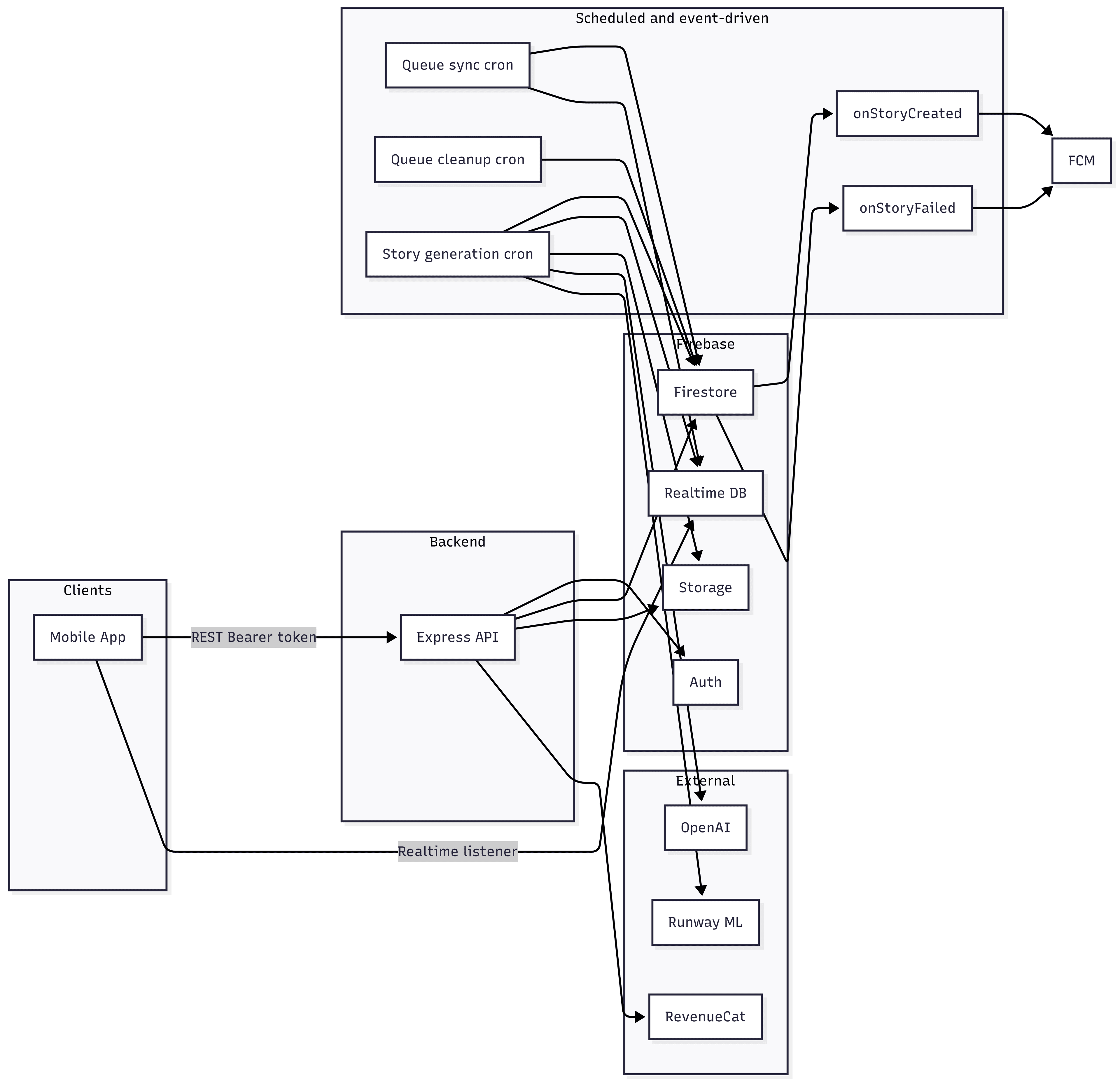
Clients talk to the system over REST. The mobile app sends requests with a Firebase ID token in the Authorization: Bearer header. There are no WebSockets on the API; the app uses Firebase Realtime Database listeners for live queue status and system load.
Application and system architecture (diagram)
Deployment Architecture
| Component | Technology | Hosting | Description |
|---|---|---|---|
| HTTP API | Express (Node 22) | Cloud Functions | Single onRequest function; handles all /api/** |
| Queue status sync | Scheduled function | Cloud Functions | Syncs Firestore queue state to Realtime DB |
| Queue cleanup | Scheduled function | Cloud Functions | Removes completed/failed queue items |
| Story generation | Scheduled function | Cloud Functions | Picks pending items, runs AI pipeline, writes results |
| Story created trigger | Firestore trigger | Cloud Functions | Sends FCM when a user story document is created |
| Story failed trigger | Firestore trigger | Cloud Functions | Sends FCM when queue item is marked failed |
| Database | Firestore | Firebase | Users, stories, queue, purchases |
| Realtime state | Realtime Database | Firebase | User and system queue counts |
| File storage | Cloud Storage | Firebase | Images, video, exports |
| Secrets and config | Environment | Firebase | API keys and webhook secrets |
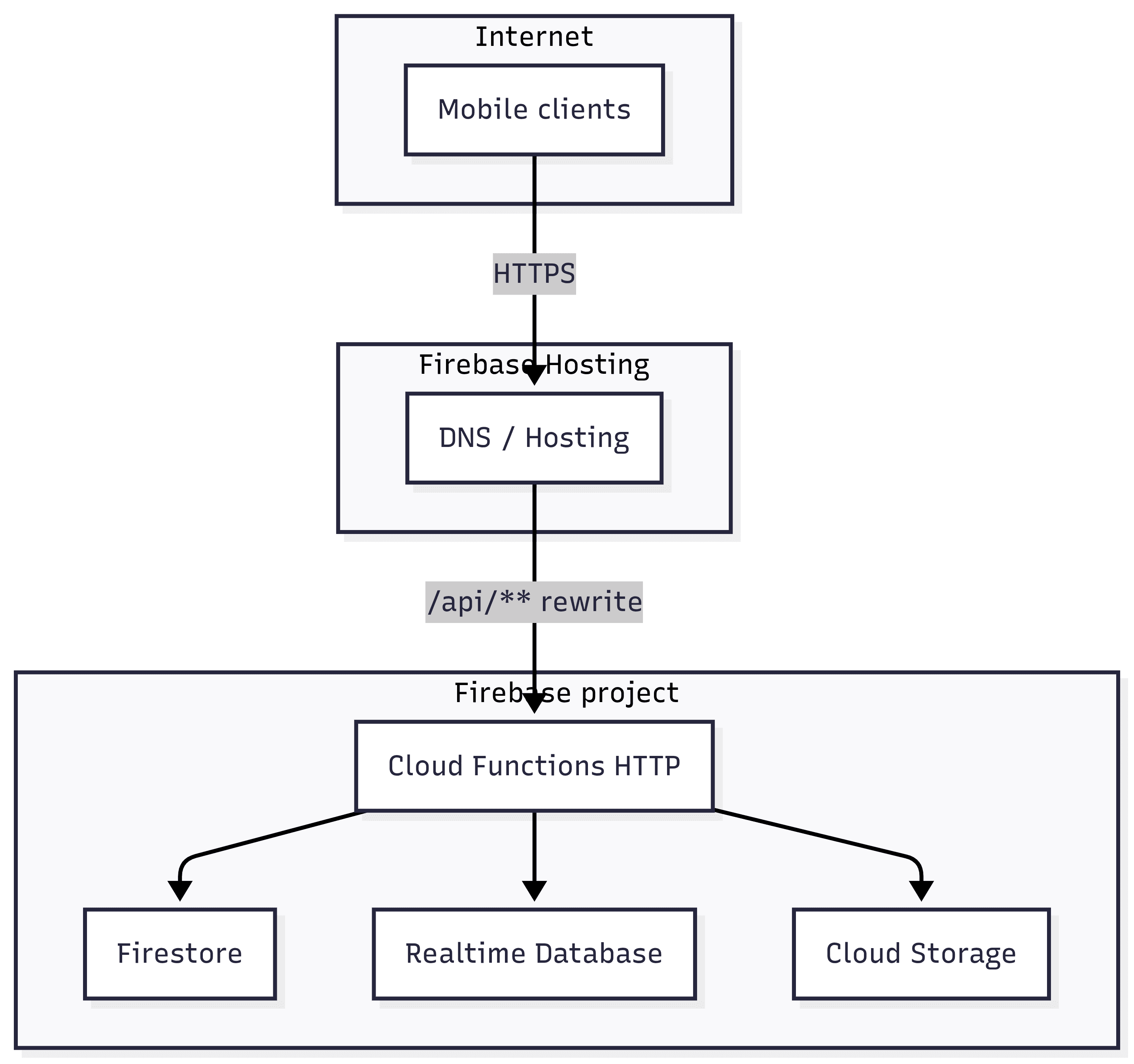
Network architecture (diagram)
Supporting Components
| Component | Purpose |
|---|---|
| Firebase Auth | Identity and ID token verification for API requests |
| FCM | Push notifications (story ready, story failed) |
| RevenueCat | Subscription and entitlement webhooks; optional server-side verification |
| OpenAI | Chat (narrative), image generation/editing, Whisper (transcription) |
| Runway ML | Video generation from image and narrative inputs |
System Design
API Design
- Base path:
/api/v1,/api/v2. - Auth: Firebase ID token in
Authorization: Bearer <token>; routes use required or optional auth middleware. - WebSocket: None; real-time data is provided via Realtime Database.
| Prefix | Module |
|---|---|
/api/v1/users | User registration, profile, FCM token, language |
/api/v1/stories | Catalog, discovery, favorites, continue watching, chapters, like |
/api/v1/purchase | App Store / Play Store server-to-server; subscription and purchase handling |
/api/v1/user-stories | User-created story submission (v1) |
/api/v2/user-stories | User-created story submission (v2, queue-based) |
/api/v2/purchase | Magic token redemption, RevenueCat webhook |
Pattern
REST with controller and service layers. Long-running story generation is handled asynchronously by scheduled functions that read from a Firestore queue and write results to Firestore and Storage; there is no in-process job queue.
Authentication and Authorization
- Method: Firebase Auth; clients obtain an ID token and send it as a Bearer token.
- Verification: Each protected request validates the token with Firebase Auth; optional auth middleware allows unauthenticated access with user context when a token is present.
- Roles: A simple role (e.g. user) can be read from the token; data is scoped by user ID (
uid).
Data Flow (High Level)
- Request/response: Mobile app calls REST endpoints for auth, stories, user-stories, and purchases; responses are JSON.
- Real-time: Queue position and system load are written to Realtime Database by a scheduled sync job; the mobile app subscribes to these paths for live updates.
- Files and exports: Images and video are uploaded to or generated into Cloud Storage; the API and cron use Storage paths in Firestore documents; push payloads include URLs for the client.
Key Backend Components
| Component | Description |
|---|---|
| Main app | Express server: routes, auth and security middleware, error handling, health check |
| User service | Registration, profile, account deletion, FCM token and language persistence |
| Story service | Catalog, discovery, favorites, continue watching, chapters, likes |
| Create-story service (v1/v2) | Validates input, enqueues to Firestore, (v1 may do inline or legacy flow) |
| Purchase service (v1/v2) | Verifies purchases (Apple/Google S2S, RevenueCat), records transactions, magic token |
| Notification service | Builds and sends FCM payloads for story success and story failure |
| Queue sync cron | Reads Firestore queue, writes user and system counts to Realtime DB |
| Queue cleanup cron | Deletes completed or failed queue documents after processing |
| Story generation cron | Fetches pending queue items, runs OpenAI + Runway pipeline, saves story and media, updates queue |
| Firestore triggers | onStoryCreated (user story doc), onStoryFailed (queue doc); invoke notification service |
| Firebase config | Admin SDK initialization for Auth, Firestore, Realtime DB, Storage, Messaging |
Domain and Feature Summary
| Area | Description |
|---|---|
| User and account management | Registration, profile, profile picture, account deletion, FCM token, language preference |
| Stories (catalog) | List stories, filter by language; get by ID with chapters and metadata |
| Discovery and engagement | Discovery feed, favorites, continue watching, like/unlike, chapter and scene progress |
| User-created stories | Submit request (image + inputs); queue in Firestore; cron generates narrative and video; result stored under user |
| Subscriptions and tokens | RevenueCat webhooks; magic token purchase and redemption; Apple/Google S2S in v1 |
| Notifications | FCM when a user story is created (success) or when queue item fails (error code and message) |
| Media | Firebase Storage for uploads and generated assets; OpenAI for images and Whisper; Runway for video |
Out of scope: Payroll, native web dashboard, and third-party white-label or reseller flows were not part of this system.
Development and Operations
Monorepo and Local Development
The repository has two main application roots: a Node.js backend and a Flutter mobile app. The backend runs as a standard Express server in local development. Data and schema live in Firestore and Realtime Database, with no separate ORM or migration framework in the codebase. The backend uses a test runner (e.g. Jest) for unit tests and a linter for style. Environment configuration is loaded at startup; no repository-specific env var names or CLI commands are documented here so the case study remains portable.
CD
Staging and production are deployed to Firebase. The backend is deployed as Cloud Functions (one HTTP function plus scheduled and Firestore-triggered functions). Hosting is configured so that requests to the API path are rewritten to the HTTP function. Secrets and environment-specific values are supplied via Firebase environment configuration or project config. There are no step-by-step runbooks or exact deploy commands in this document.
Summary
The backend is a production-grade Node.js and Express API deployed on Firebase Cloud Functions, with Firestore, Realtime Database, and Cloud Storage as the data and media layer. It provides a single REST surface for the mobile app, queue-based AI story generation (OpenAI and Runway ML), real-time queue status via Realtime Database, and push notifications via FCM. Local development runs the same Express app against Firebase-backed services; the same codebase is deployed as an HTTP function and as scheduled and event-driven functions for the pipeline and notifications.