Air Duct Cleaning Service
Confidential
2025
Executive Summary
This system is a service management platform built for an air duct cleaning and insulation company. It provides a single platform for administrators, managers, and field employees to manage scheduling, vehicle fleets, resources, request workflows (tools, clothing, time-off), and financial transactions (expenses, spiffs). The system consists of a REST API backend, a web portal for administrators and managers, and a mobile app for field employees. Together they deliver self-service for employees, location-level oversight for managers, and organization-wide configuration and audit for administrators.
Problem Statement and Goals
Problem Statement
- Fragmented visibility: Field operations lacked a centralized view of schedules, vehicle assignments, and resource availability.
- Disconnected processes: Requests for tools, clothing, and time-off were handled through ad-hoc channels (email, spreadsheets, verbal requests), leading to delays and lost visibility.
- Manual coordination: Managers spent significant time coordinating approvals, tracking expenses and spiffs, and communicating with dispersed field employees.
- Audit gaps: Financial transactions and approvals lacked a consistent audit trail for compliance and reconciliation.
Goals
- Reduced request turnaround: Request workflows move from submission to approval/completion with clear status visibility.
- Single source of truth: Schedules, assignments, and resource data centralized and consistent across the organization.
- Audit trail: All approvals and financial transactions logged for compliance and reconciliation.
- Field employee adoption: Employees use the mobile app for day-to-day self-service instead of relying on managers or office staff.
System Architecture
Application Architecture
| Application | Path | Technology | Target Users |
|---|---|---|---|
| API | apps/api | FastAPI, Python 3.12, PostgreSQL, Redis, Celery, AWS S3 | Backend service |
| Web Portal | apps/web | React, Vite | Administrators, Managers |
| Mobile App | apps/mobile | Expo, React Native | Field Employees |
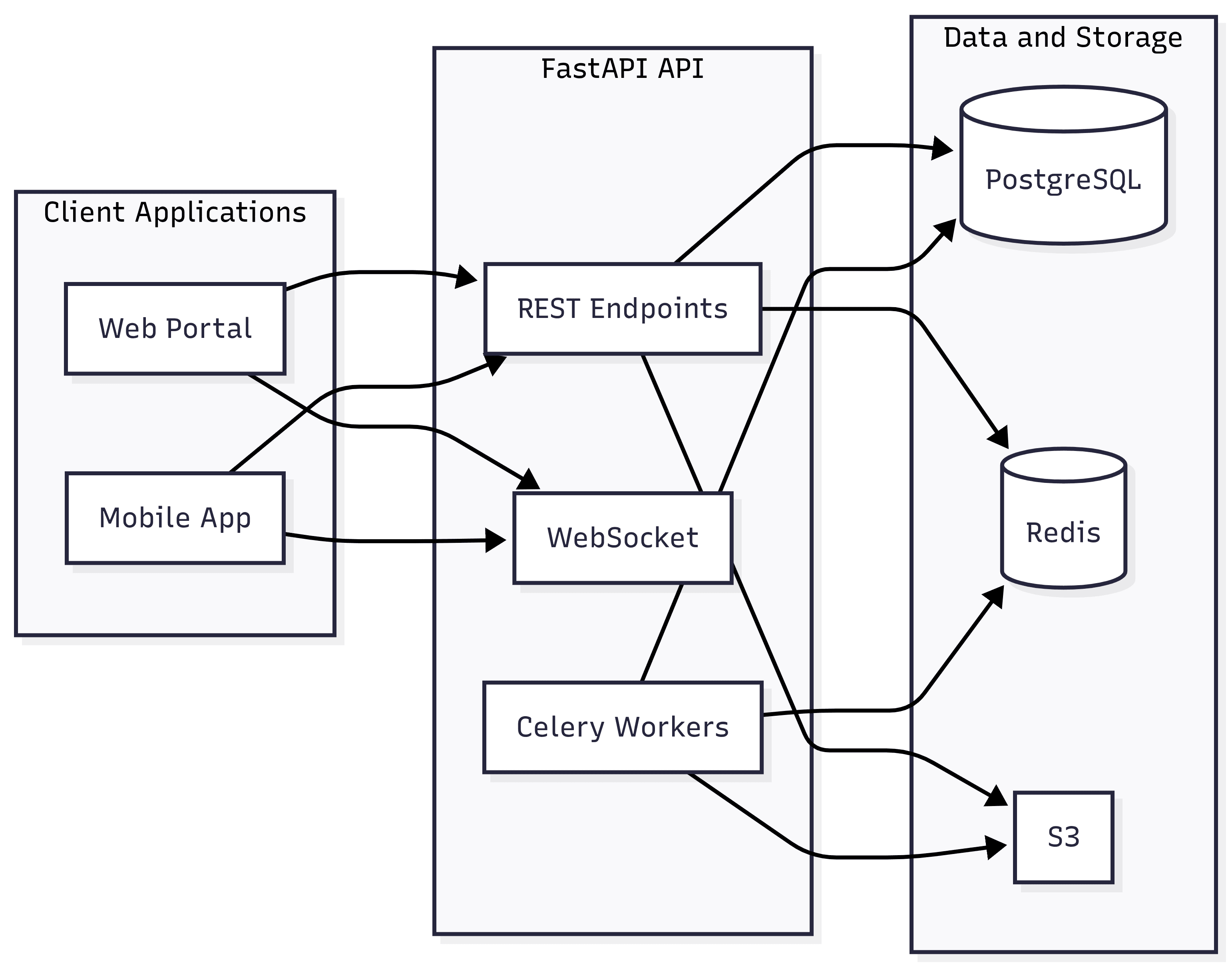
All clients consume the same REST API and use JWT authentication. WebSocket is used for real-time in-app notifications.
Deployment Architecture
| Component | Technology | Hosting | Description |
|---|---|---|---|
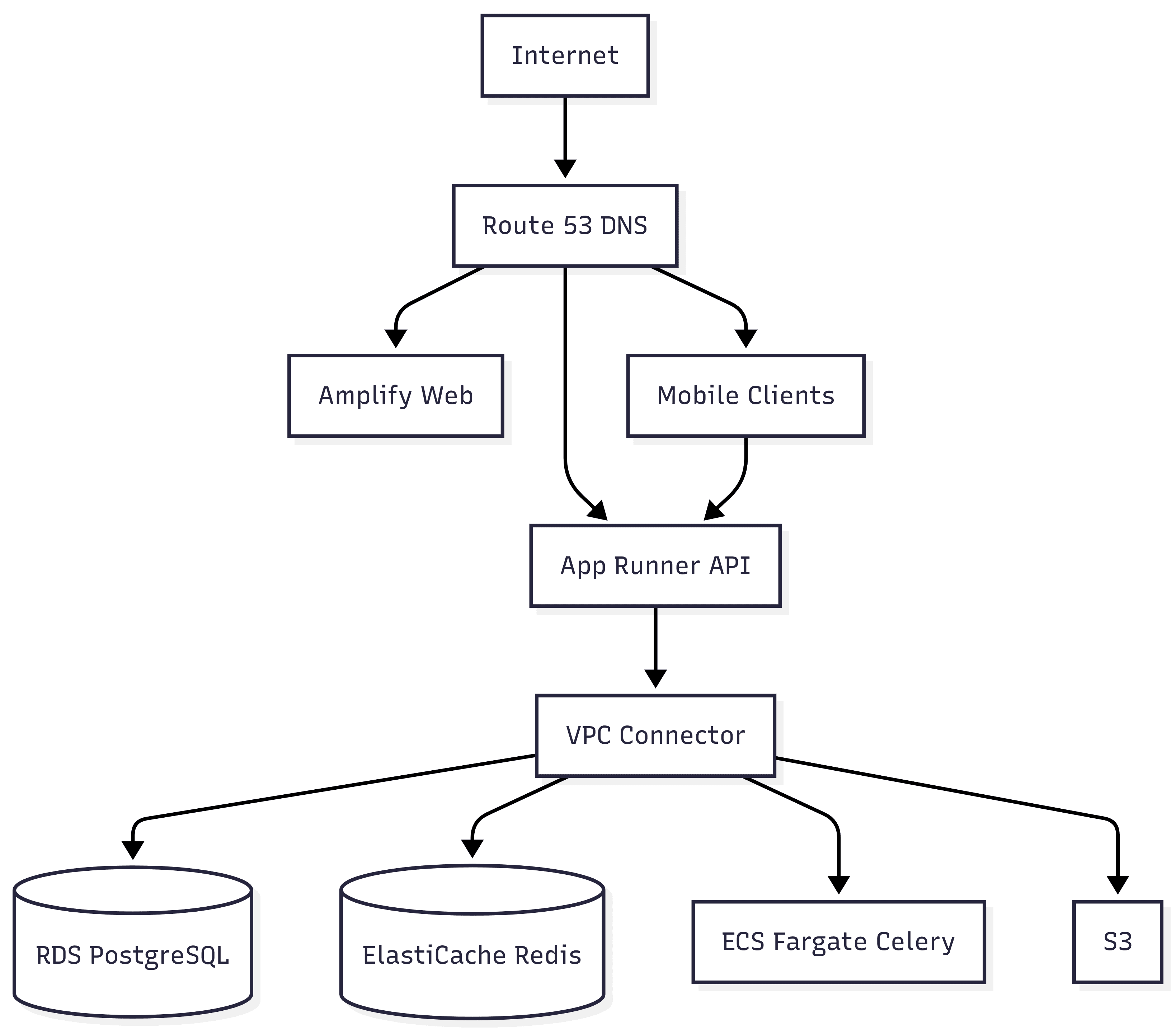
| API | FastAPI, Uvicorn | AWS App Runner | REST API, WebSocket; HTTPS, auto-scaling |
| Celery | Python | AWS ECS Fargate | Background workers (email, SMS, exports) |
| Web Portal | React, Vite | AWS Amplify | Admin and manager UI; CDN, SSL |
| Mobile App | Expo, React Native | App Store, Google Play (EAS) | Field employee self-service |
| Database | PostgreSQL | AWS RDS | Primary data store |
| Cache / broker | Redis | ElastiCache | Celery broker, cache |
| File storage | — | AWS S3 | Uploads, exports, backups |
| Secrets | — | AWS Secrets Manager | DB credentials, JWT, API keys |
Network Architecture
Supporting Components
| Component | Purpose |
|---|---|
| Lambda (restore-db) | Restores PostgreSQL from a plain SQL dump in S3 into RDS (e.g. staging, prod) |
| Twilio | SMS (OTP, notifications) |
| AWS SES | Transactional email |
| Firebase Cloud Messaging | Push notifications (Android) |
| APNs | Push notifications (iOS) |
| Sentry | Error tracking and performance |
System Design
API Design
- Base path:
/api/v1 - Authentication: JWT Bearer (
Authorization: Bearer <token>). Login:POST /api/v1/auth/login. - WebSocket:
WS /api/v1/ws/notifications/{user_id}?token=<jwt>for real-time notifications.
API modules:
| Prefix | Module |
|---|---|
/auth | Authentication |
/users | Users |
/locations | Locations |
/tenants | Tenants |
/audit-logs | Audit logs |
/vehicles | Vehicles |
/resources | Resources |
/types | Reference types (catalogs) |
/tools | Tools |
/clothing | Clothing |
/tool-requests | Tool requests |
/clothing-requests | Clothing requests |
/expenses | Expenses |
/spiffs | Spiffs |
/notifications | Notifications |
/device-tokens | Device tokens (push) |
/referrals | Referrals (partner companies) |
/emergency-contacts | Emergency contacts |
/repair-requests | Repair requests |
/suggestions | Suggestions |
/media | Media upload/download |
/preferences | User preferences |
/schedule | Vehicle schedules |
/specializations | Specializations |
/time-off-requests | Time-off (PTO) requests |
Pattern: REST resources with controller and service layers; Celery for asynchronous work (email, SMS, export generation).
Authentication and Authorization
- Auth methods: Email/password and phone OTP (employees).
- Tokens: JWT (access and refresh); validated on each request.
- Authorization: Role-based access control (Admin, Manager, Employee). Data scoped by tenant and location; users are assigned to locations.
Data Flow (High Level)
- Request/response: Web and Mobile send HTTPS requests to the API; the API reads and writes PostgreSQL. Redis is used as the Celery message broker and for cache.
- Real-time: In-app notifications are delivered over WebSocket. Mobile push uses FCM (Android) and APNs (iOS); device tokens are registered via
/device-tokens. - Files and exports: Uploads go to S3 via the API. Export generation and delivery (e.g. email) are handled by Celery tasks.
Key Backend Components
| Component | Description |
|---|---|
| FastAPI app | Main HTTP and WebSocket server; mounts all routers at /api/v1 |
| Celery app | Same codebase as API; entrypoint celery -A src.celery_app worker (ECS uses --pool=solo) |
| Alembic | Database migrations in apps/api/alembic/versions/ |
| Entities | SQLAlchemy models (users, locations, vehicles, schedule, expenses, spiffs, tools, clothing, requests, notifications, etc.) |
Domain and Feature Summary
| Area | Description |
|---|---|
| User and organization management | Users, tenants, locations, roles (Admin, Manager, Employee) |
| Scheduling | Daily scheduling, vehicle assignments, service management |
| Vehicle fleet | Vehicles, maintenance, repairs, odometer tracking |
| Request workflows | Tool requests, clothing requests, PTO (time-off) requests |
| Financial tracking | Expenses, spiffs, approval flows |
| Resources and suggestions | Resource library, suggestions, referrals |
| Notifications | In-app (WebSocket), push (mobile), email (SES), SMS (Twilio) |
Out of scope: Payroll or accounting system integration; automated inventory management or procurement; native iOS/Android codebases (Expo managed workflow in scope).
Development and Operations
Monorepo and Local Development
- Workspace: pnpm monorepo with Turbo. Apps:
apps/api,apps/web,apps/mobile. Shared:packages/api-client,packages/shared-types. - API (local): Make targets from repo root:
make db-up(Postgres, Redis),make migrate,make create-admin,make dev(API + Celery).
CI
GitHub Actions:
| Workflow | Scope | Jobs |
|---|---|---|
| ci-api | API code | Lint (ruff, black), test (pytest), optional migration checks |
| ci-web | Web, packages | Test (Vitest), lint |
| ci-mobile | Mobile, packages | Test (Jest), lint, typecheck |
| ci-e2e-web | Web, API, packages | E2E (Playwright), web integration tests |
CD
- deploy-staging: Triggered on push to
main. Single pipeline: Terraform (staging) then deploy API (App Runner), Celery (ECS), web (Amplify), mobile (EAS). - deploy-production: Triggered on tag
v*(e.g.v1.2.3). Same pipeline for production. - Secrets: Runtime secrets (Postgres URL, JWT, Twilio, Expo token, etc.) in AWS Secrets Manager; Terraform and workflows consume as needed.
Summary
This system is a production-grade, multi-tenant field-service platform: one backend (FastAPI + Celery), one web app for admins/managers, and one mobile app for employees, with shared types and API client, full request and financial workflows, and a clear path from local dev to staged and production deploys on AWS via Terraform and GitHub Actions.